If making more money with email marketing is one of your new year’s resolutions…
You may be particularly interested in the 7 types of stories you should be sending to your email list:
Genesis stories: people want to know the story behind why you started something Idealist stories: illustrate your personal & business values/philosophies with a story Iron Fist stories: Tales of battle, struggle and victory (or lessons from losses) — either of yours or your customers’ Catalyst stories: Moments, decisions, interventions that caused critical change Journalist stories: commentary on trending topics or news or little-known truth behind well-known stories Adventurous stories: Crazy, funny stuff going on in your life Status stories: Elevate your authority with big name clients, famous friends, recognition, accomplishments.
You’ll have to forgive me. I was really trying to be clever with this bootleg rhyming thing.
Until recently, this training was only available to Inbox X-Factor members. I’m giving you access now to help you kick 2021’s b.u.t.t.
This is the most powerful copy principle I can share with you.
It’s shockingly simple to understand. Once you get it, it can change everything for you.
And in my humble opinion, it’s significantly more powerful (and easier to use) than Blair Warren’s famed One Sentence Persuasion.
I call it the “Red Bull” copy secret…
… and its the foundation of everything you need to know to sell more of your product or service.
Really.
This video gives you a quick overview (less than 4 minutes) along with the story behind the secret.
Now, if you don’t want to watch the video, let me give you the formula in one sentence:
Sell the transformation your buyer wants… using what he already has… with just a little help from you.
That’s how Red Bull works.
Buyers want alertness without having to change their sleeping habits. They want energy without changing their diet or exercise routines.
They buy the magical potion to fix things for them.
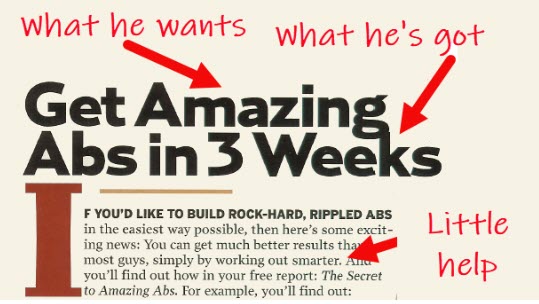
Here’s an example of what this might look like in sales copy:
Notice that you don’t have to start a new workout. You just have to get this report that shows you a smarter way of doing what you’re already doing.
This is more than just simplicity or ease — although that’s a part of it.
In general, people don’t want to change their lifestyle, habits or decisions.
(They may SAY they want to change, but that’s a lie.)
If your copy reassures the reader that he can achieve his stated goal… using the things in his life he’s already comfortable, familiar and even happy with…
You win the game.
Of course, you have to be honest. If you sell bottled water and energy-boosting meal plans, your copy can’t promise Red Bull.
That said, if you can make your products so they relieve the buyer of effort, responsibility and change, the more you’re likely to sell.
Make sense?
Let me point out one more thing.
In the beginning of this email, I said that once you understand this principle, “it can change everything for you.”
I told you that you don’t have to change. This secret changes your results FOR YOU.
This stuff works.
Now it’s time to make it work for you.
P.S. I am a big fan of Warren’s One Sentence Persuasion. It’s a powerful framework for crafting compelling messages and being a persuasive person.
Despite all the craziness, 2020 has been a phenomenal year for my clients.
Or maybe more accurately, 2020 has been a screaming success because of all the craziness.
Last week, I revealed 3 simple “secrets” behind that success in my first room on Clubhouse.
Specifically, how we’ve generated $17 million from email year-to-date.
You may not have been part of that Clubhouse conversation (it was a small audience)… and those conversations aren’t recorded…
So I’ll quickly tell you what I shared.
“Secret” #1: Be consistent and persistent
My clients email daily. And they make offers in every single email.
You can probably send more emails than you do. (That goes for me, too.)
One of the main points I made was that unsubscribes go up when you email LESS.
You let people forget who you are and why they were excited to hear from you.
Depending on your business and your capabilities, I recommend no fewer than 1 email per week. Most businesses can send 3 or more — and the only difference you’ll see is more money in the bank.
“Secret” #2: Curiosity
Don’t give away the punchline in every email.
Tease a juicy benefit… tantalizing opportunity… or potentially imminent danger…
And make the reader click a link to find out exactly what you’re talking about.
Create emotional tension that can only be resolved by clicking… and give your sales pitch on the other side of the click.
There’s a right way and a wrong way to do this.
You can get more insight into how curiosity works — and the right and wrong ways to use it in your email — in this video.
“Secret” 3: Easy on the education
I’ve discovered that a lot of entrepreneurs believe they have to educate prospects into buying from them.
Education can be helpful. But the truth is, information isn’t what sells.
You know that people buy on emotion. In a way, they’re buying the emotion itself.
(That’s one of the reasons people don’t do anything with the stuff they buy. Making the purchase provided the emotional payoff.)
Your copy’s job is to stimulate the emotions — hope, desire, guilt, fear, etc. — that make your prospects take action.
There’s no shortage of information.
But your prospects are dying for emotional MOTIVATION.
So be careful how you educate.
Each fact you present should be designed to inflame desire… not to make the reader smarter.
That sounds cynical, I know.
But when you’re going for maximum profits, it’s an approach likely to serve you well.
Having read this far, you’ve figured out why I put “secrets” in quotations.
They’re not unknown concepts. They’re just underutilized.
If your email marketing efforts are coming up short, these 3 ideas could be helpful.
What was your initial reaction to the Netflix documentary The Social Dilemma — or even just discussions about it?
(I’m assuming you’ve had at least one discussion about it. Seems like everyone was talking about it a few weeks ago.)
Here’s a review I saw that captures a snippet of the conversations I had after the film was released:
“This exposes truths about big data, manipulation, & warnings from the people who designed Facebook, Google, Instagram, Twitter, etc. Everyone should definitely watch this to understand how these social media platforms are using us and how Humanity will be destroyed by Technology in the near future.”
A lot of people are “mad” at the social media companies, which Netflix should be counted amongst.
As a marketer, what was YOUR reaction?
The proper response should have been inspiration.
Because the film is practically a field guide illustrating how to build an army of happy little addicts…
And we marketers should be taking notes.
Do you want your own army of happy addicts?
You can start taking notes right here, right now.
(BTW, I’m curious to know what your reaction to THAT statement was. Leave a comment and let me know.)
I’ll just briefly hit on a few points that are especially important.
What’s Wrong with an Echo Chamber?
One of the big criticisms leveled by the producers of The Social Dilemma is that Facebook and others feed you more and more stories to reinforce a particular opinion… one that you hold already.
News flash: humans already do this automatically. It’s called confirmation bias.
People enjoy the feeling of being right, smart, and on the right side. The crave it.
You should harness that reality.
When planning out your messaging, you must use your ideal customer’s view of reality as the starting point.
Don’t fight your prospect’s brain.
Stake Your Claim
To a certain extent, you have to own real estate in your prospect’s mind.
How do you do that? Through regular, consistent, engaging communication.
Our brains are biased towards information we’ve heard recently and repeatedly.
You’ve heard that a lie told often enough is believed. But it’s not about the lie. It’s about the repetition.
A few things you can do to claim more real estate between your prospect’s ears:
Frequent communication via email, YouTube, social channels. You don’t have to use them all, but the more you use, the more you can dominate your prospect’s time and the more opportunities you’ll have to reinforce your ideas.
If possible, be present in the physical environment. Get a book, a t-shirt, a printed checklist, something physical into homes or offices. When you can do that, you’re in a rare group — and as a result, people convince themselves you’re more important.
Studies also show there’s a stronger and longer-lasting neurological response to physical marketing (e.g. direct mail) over digital version of the same ads.
Impact ONE THING that’s part of your prospect’s daily routine. Now you own part of his day.
A recent poll found that 80% of people check their phones before doing anything else in the morning. It’s a routine set by social media (and email).
What part of the day can you own?
By the Power Vested in Me
A huge reason The Social Dilemma is so hard-hitting is that it’s filled with admissions from THE experts on this topic: the people who designed these addictive apps.
People are eager to defer to authorities and experts, sometimes without even realizing it.
I’ve talked about authority several times in the past, so I’ll just mention one important point.
Your personal story — how you came to experience and understand the idea you’re trying to share — is likely to carry more weight than scientific studies (which make fantastic supporting arguments).
Your story makes you an authority, whether or not you have credentials or position.
Now listen…
This topic can make some people squeamish. I get it. Most people don’t want to feel manipulative.
As a marketer, it probably happens more than you think.
(Civilians don’t really understand what we do.)
I remember sitting in church with my family a few years ago… when the preacher — who happened to be my father-in-law — started railing on the vile schemes of marketers.
Free trials, for example.
Marketers know some people won’t cancel before the free trial is over, so why do we “trick” people into spending money that way?
That part of the sermon probably only lasted 2 or 3 minutes… but it seemed much longer.
I know marketing isn’t evil — I dealt with that false belief long ago.
But it was still uncomfortable.
Good thing the preacher didn’t call me out by name.
The church is full of civilians who don’t understand what I do, so I’m pretty sure no one knew he was talking about me.
He probably didn’t even know he was talking about me!
Has anything like that happened to you?
(If you have a good story, please reply to this email and share. I’d love to hear it.)
Let me clear up a few things.
Copywriting and marketing are NOT evil.
You probably already know that or you wouldn’t have signed up to hear from me.
Marketing is leadership… and I know you’re using it to improve people’s lives
Better marketing = more lives transformed for the better.
If you’re selling something that helps people, promoting it aggressively makes the world a better place.
Free will always wins.
We marketers can’t force anyone to act against their own best interests.
All we can do is paint a clear picture of a specific outcome our should-be buyer already wants… and make it as easy as possible for him to say “yes”
Jonathan Edwards, an 18th century preacher (which makes him a little older than my father-in-law), wrote that people…
“…always act according to the strongest inclination they have at the moment of choice.“
You make the big bucks when you can create moments of choice where the reader’s strongest inclination is to buy your offer.
Email gives you the best opportunity to create moments strong inclination… over and over
I recorded a video describing a few of my best techniques for doing exactly that.
One of the strategies is what I call intense opportunity curiosity…
Which was the real secret behind the $218,337 5-email campaign I told you about last week.
This video training will be exclusively available to Inbox X-Factor members.
No big sales pitch. I still haven’t written the sales page.
But if you’d like to learn more about how I’ve been making MORE money with email instead of less (which so many people are complaining about these days)…
You’ll want to see the video I’m uploading tomorrow.
Plus, you get weekly email plans… winning subject line templates… and more.
$99 a month (no contracts) is a small investment to help you make your email list significantly more profitable — and to spend less time doing it.
Just one of the ways I’m striving to make the world a better place.
We have a tendency to make copywriting (and persuasion in general) more complicated than it needs to be.
A lot of the blame can be placed on the countless “experts” who make it seem complicated…
I fear I’ve fallen into that category at times.
Today, we’re going to simplify things.
At it’s core, copywriting is helping someone make a decision that will improve his life in a specific way.
Humans make most of their decisions — not counting habitual “autopilot” programs we run for so many parts of our lives — based on emotion.
You already knew that.
One of the most effective ways to make another human feel emotion is to feel it yourself.
Emotions are contagious like a virus — and symptoms start showing up FAST.
When you sit down to write, start out by feeling the feeling you want you reader to experience.
Excitement… Fear… Hope…
Let those feelings bleed into your copy.
You already do this in face-to-face conversation — and even more so when it’s someone you care about.
Your emotions are transferred to the audience to some extent.
And when he’s feeling the way you feel, you have the opportunity to lead him where he needs to go to improve his life in the specific way only you can deliver.
Make sense?
Have a heart-to-heart conversation (through your copy) with your readers this week.
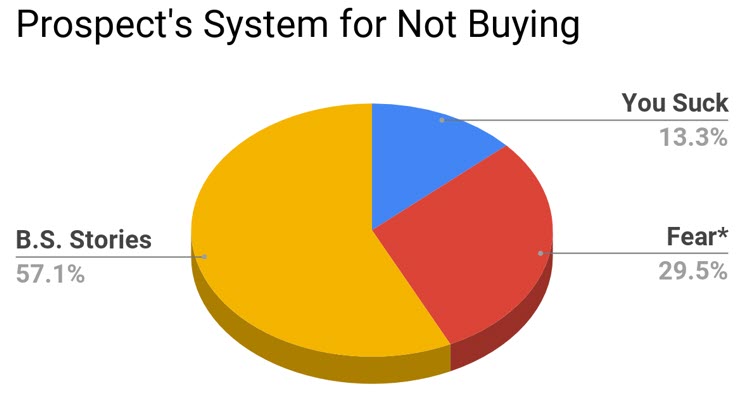
Your should-be customer or client has developed a sophisticated system for NOT buying from you.
(The system is deadly effective, even though he was hardly aware that he was building it.)
One of the main components of this system is disbelief. No surprise, right?
But what most marketers don’t consider is that disbelief comes in two flavors:
1. Disbelief about your or your product/service
and
2. Disbelief about his own ability or worthiness to experience the transformation you promise.
In other words…
Your prospect can believe that you help save marriages… and disbelieve you can save HIS marriage.
To neutralize this part of the anti-buying system, you have to
1. Prove that you can deliver a result
and
2. Prove that you can deliver a result FOR HIM.
I want to talk about #2
How do you do it?
Identify the B.S. stories he tells himself… about himself.
A significant percentage of your prospects will never buy from you — not because they don’t want what you’re selling or because they don’t believe you’re good at what you do…
… but because of their limiting (dis)beliefs.
*All figures are estimates
Some generic B.S. stories include
“I’ve failed before, so trying again is pointless”
“I’m not smart/handsome/wealthy enough”
“People who look like me don’t/can’t do that”
“I haven’t paid my dues yet”
“I don’t deserve to be rich/happy because I did XYZ in the past”
You can uncover more specific crippling B.S. stories by talking (or having your team talk) with people in your target audience.
Get on the phone. Send surveys (but take responses with a grain of salt). Spy on them online (social media, Reddit, Amazon reviews, etc.).
You’ll gain fascinating insight you can to overcome objections in your copy.
Showcase People Like Him Who Got the Result
Once you know some of the B.S. stories, find examples about people who contradict those stories.
The more unbelieving prospect see himself reflected in your marketing messages — including his dreams, challenges, and B.S. stories — the more your message will resonate…
And the weaker his disbelief will become.
Leverage A Unique Mechanism
Position your offer as a special, proven approach your prospect has never seen before.
Show him why it’s different — and why other solutions fail.
Your unique solution helps him understand why he may have struggled in the past. And it can give him hope for future success.
Make it Ridiculously Easy to Take the First Step…
Offer a sample. A free or low cost trial. A 7-day challenge.
One of the main reasons people fail is because they never MOVE. Get them to take the first step and you unlock optimism and even confidence by default.
That confidence can force your prospect to re-examine his disbelief — especially if you…
Give Him a Quick Win
Provide information or action steps that will give him some forward momentum.
It only takes a little… and you can deliver it right inside your marketing copy if you like.
This give the prospect more confidence and trust in you. More importantly, it builds confidence and trust in his own ability to reach his goal.
An obviously you’re the person best equipped to help him do it.
Now, there’s something to be said for not convincing anyone who’s not already sure he wants to work with you.
But no matter how you approach your own business growth, it’s helpful to identify the disbelief and B.S. stories that hold your prospects (and customers) back.
You can work that knowledge into your marketing or use it to improve results inside your paid offers.
I hope this helps you grow in one way or the other.
Have a productive day.
P.S. Overcoming a prospect’s disbelief in this way is part of “killing them softly” with their own song.
You don’t have to wait long to give them an opportunity to buy.
It can happen in the first email in a welcome sequence.
It can happen directly in a Facebook ad.
Don’t be fooled.
When you make the right offer to the right person, the right time is probably now.
Keep this in mind…
The classic AIDA formula still applies.
You have to get attention and interest before you can direct desire toward your offer. (That can happen faster than you may think, too.)
In the same way that you can start decorating for Christmas much earlier than many people think… You can start selling before you’re done throwing Gary Vee-style jabs.
After you’ve grabbed your should-be buyer’s attention and started generating interest in what you’re talking about, it’s safe to start moving toward the sale.
Let’s get it!
P.S. I just recorded a video diving deeper into this in the Inbox X-Factor membership.
I honestly believe it’s one of the most valuable trainings I can share right now.
If you’re aggressively growing your email list, these insights could be worth millions of dollars for you.
So an irresistible offer should be driven by “desire stacking.”
Which brings me back the offer I mentioned at the beginning of this email.
One of the most attractive, no-brainer offers I’ve ever seen.
A chance to rent out the mansion from The Fresh Prince of Bel-Air.
You may have seen this. Airbnb posted the link about a week ago, and Will Smith gave a video tour on YouTube on Monday.
When you see this, what’s your instant reaction?
For me — and countless people like me — the response is…
1st: WHERE DO I SIGN UP?
2nd: Please, God. Let me get a spot before they’re sold out.
I did not wonder how much it costs (and I definitely didn’t try to compare price vs. other lodging in the area).
Flying cross-country in a pandemic didn’t dampen my excitement.
If I could have grabbed a spot, nothing would have stopped me from booking a night.
Of course, different people have different responses. But for the right people, this offer is totally irresistible.
And the core reasons the Fresh Prince mansion is a no-brainer… are the same reasons behind most offers that are too sweet to ignore.
Let’s quickly break down 4 of them.
1. Status
Your offer should raise your prospect’s status — in his own eyes or the eyes of others.
When he says “yes,” what does he get that instantly makes him feel better about himself… like he’s just jumped to the next level (or at least finally discovered the elevator)?
How will he look to his (future) wife? His kids? His golf buddies. His competitors?
What will he have that others WISH they had?
A few bonus ebooks ain’t gonna get it.
2. Story Factor
Does buying from you give the customer an exciting, envy-inducing story to share at his next dinner party or networking event?
Does it change the story he tells himself about himself?
Or the story his parents tell to brag to their friends about their son?
Does it give him content that will get tons of likes on social media?
You might be shocked how much people will spend or suffer through to have a good story to share.
Think of all the great stories you could tell after staying at the Bel-Air mansion! And unlike a lot of business stories, you can share this one with just about everyone.
3. (Aspirational) Identity
Every conscious decision we make is influenced by the way they see ourselves and our place in the world.
If your offer connects to your should-be buyer’s identity in a unique way…
Helps him express externally how he sees himself internally…
Or moves him closer to being the person he wishes he was, letting Clark Kent be Superman, as it were…
It taps the deep-rooted desire.
How can your offer link your buyer to that identity?
4. Exclusivity
You don’t have to convince anyone there’s a limited amount of nights to book a stay in a mansion.
And you don’t have to convince anyone there’s high demand for the available slots.
But only about 365 people will have the privilege of securing one in the next year — if Airbnb keeps it open that long.
That kind of exclusivity and scarcity amplifies desire that’s hard to replicate in any other way — as long as you’re offering something people want in the first place.
It multiplies the status and story factor. Being part of such a small group boosts the impact to identity.
Leveraging exclusivity makes your offer significantly harder to resist. Use it to your advantage.
So there you have it.
When you’re thinking about how to make your offer as compelling as possible, remember…
Put value on the back burner. It’s all about stacking desire.
***UPDATE***
When I sent this article out as an
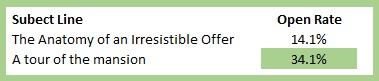
I sent my broadcast email newsletter earlier this week, I tested two very different subject lines.
One promises a valuable lesson about a topic I hear a lot of questions about…
The other seems to offer a voyeuristic peek into the lifestyles of the rich and famous.
I have to admit, the split test results surprised me:
If you’ve read my emails before, you may assume the mansion I promise a tour of is my own home.
(That’s kinda deceptive, but not maliciously so).
After the first hour, the voyeuristic subject line was opened TWICE as many times as the benefit subject line. Honestly, I thought the “Anatomy” subject line would win.And I definitely didn’t think either version would double the open rate of the other. There are a few takeaways here:
TEST. You really never know what will work until you get it out to the market
I’ve said it a thousand times, but must have forgot when I sent this test..
Sometimes entertainment is the most valuable benefit you can provide. That subject line brought MTV Cribs to my readers’ inbox.
If you want to keep your open rates from dropping over time, entertainment value is practically nonnegotiable.
People really do want to go behind-the-scenes, especially if your business has a personality component. They’re curious about the non-business stuff going on with you and others in your industry.
One of the top copy rules is that the copy must be about the reader. And while the “mansion” subject line doesn’t seem to be about the reader, it really is. It’s providing something they want: entertainment… escape… scratching the curiosity itch… aspiration… connection.